AGESI Welcomes COP30 Outcomes, Reframes Africa as a Global Green Investment Opportunity
The Africa Green Economy and Sustainability Institute (AGESI) has welcomed the closing remarks of the Group of 77 (G77) and China at COP30, describing their focus on climate finance, adaptation, and just transitions as a turning point for Africa’s position in the global green economy.
According to AGESI, the world must move beyond narratives of African vulnerability and recognise the continent as a major destination for green investment.
Africa as an Investible Continent
AGESI reiterated that scaling up climate finance is essential, but the institute also stressed that this shift requires tools that build investor confidence and convert political commitments into clear investment pathways.
This is where AGESI’s flagship tool, the Africa Green Opportunity Index (AGOI™), plays a crucial role. AGOI™ uses localised, risk-adjusted data to turn high-level climate ambition into precise, sector-specific investment signals.
“The G77 and China have rightly placed climate finance at the core of COP30 outcomes. Africa is not a continent of risk. Africa is investible.”
— Dr. Eugene Itua, Executive Director, AGESI
AGOI™: Closing the Climate Finance Trust Gap
AGESI emphasised that the AGOI™ framework aligns strongly with G77/China’s calls to triple adaptation finance and to operationalise the Just Transitions Mechanism.
AGOI™ measures opportunities across five core pillars:
-
Green Energy
-
Climate-Smart Agriculture
-
Circular Economy
-
Nature-Based Solutions
-
Social Equity
These pillars ensure that climate investments support environmental resilience and deliver inclusive economic growth.
“AGOI™ proves that Africa’s resilience and innovation can drive global green growth.”
— Charles Ozulumba, AGESI
Leveraging Africa’s Demographic Advantage
AGESI highlighted that Africa’s young population is one of the most powerful drivers of future green growth. AGOI™ turns this demographic advantage into measurable prospects by quantifying employment potential and identifying the markets where innovation, infrastructure, and workforce skills align.
For instance, AGOI™ shows that every renewable megawatt can generate up to 10 local jobs. It also identifies opportunities that align with the Paris Agreement and regional initiatives such as the AfCFTA.
AGOI™ places strong emphasis on social equity by highlighting opportunities that expand women’s participation and create quality jobs for young people in climate-smart agriculture and renewable energy.
A Call for Collaboration
AGESI encouraged governments, investors, philanthropies, and development partners to work with the institute to scale AGOI™ across the continent. Such collaboration can unlock green capital, strengthen climate resilience, create jobs, and support value-chain development for shared prosperity.
“Partner with us, invest in AGOI™, or help amplify our work. Your support can accelerate Africa’s green future.”
— AGESI
Interested partners are invited to schedule a call or request the AGOI™ briefing deck.
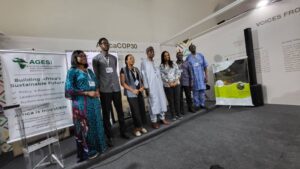
Strategic Engagement With UNDP at ACS2
At the Africa Climate Summit 2 (ACS2) in September, AGESI met with senior United Nations Development Programme (UNDP) officials to explore partnership opportunities for expanding Africa’s green economy.
The meeting brought together:
-
Dr. Eugene Itua, Executive Director, AGESI
-
Dr. Matthias Z. Naab, Director, UNDP Regional Service Centre for Africa
-
Dr. Zeynu Ummer, Director, UNDP Resilience Hub for Africa
-
Charles Nyandiga, UNDP Regional Team Leader for Environment
The discussions underscored a shared commitment to data-driven solutions that unlock investment and strengthen climate resilience.
AGESI Commends COP30 Demands, Reframes Africa as Global Green Opportunity