Bangkok Policy Statement: Resilient Infrastructure and Accountable Climate Finance
An African leadership proposal for ministers and development finance institutions
We call on leaders meeting in Bangkok to make resilience, integrity and credible evidence a practical condition of major infrastructure investment.
A road must remain usable when rains intensify. A water system must serve people through drought. Public finance must cover maintenance and recovery as well as construction. The measure of success is the service people receive throughout a project’s life.
Climate risks and debt pressures make weak investment decisions increasingly costly. Across Africa, the response must combine local knowledge, capable institutions, affordable finance and stronger public accountability. Communities must help shape decisions and be able to challenge failures.
We propose a country-led pilot of FFIAS™ to organise three questions before an investment moves forward. A critical failure in design, governance or evidence must trigger a documented correction. A strong score elsewhere cannot erase that failure.
The decision sought in Bangkok
Invite willing governments and financing partners to agree a funded 100-day pilot. Bring the commitment and early findings to COP31, then publish independently reviewed results at day 100 to inform wider infrastructure practice.
Prepared by Dr. Eugene O. Itua
Executive Director, Africa Green Economy & Sustainability Institute (AGESI)
CEO, Natural Eco Capital
THE PROPOSED FFIAS APPRAISAL
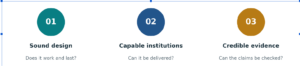
Three questions before investment
Leaders need a clear decision supported by technical work they can check.
1 Is the project well designed
Will it deliver a useful service, avoid unacceptable harm, remain affordable, withstand future climate conditions and treat people fairly? Test future scenarios over the asset’s life and compare alternatives, including nature-based options.
Evidence to see: A climate stress test; whole-life costs; funded maintenance; environmental and social assessment; distribution of benefits and burdens; and a plan to adapt as risks change.
2 Can the institutions deliver it
Is there a capable, funded owner? Was procurement fair? Do contracts assign maintenance and remedy responsibilities? Are legal obligations understood, conflicts disclosed, safeguards enforced and complaints addressed?
Evidence to see: Permits and compliance records; procurement disclosures; enforceable responsibilities; staffing and budgets; independent oversight; and an accessible grievance process.
3 Are the claims supported by credible evidence
Can reviewers trace important claims to data, sound methods and independent checks? Label evidence as verified, reported, inferred or unavailable. Record uncertainty and use community knowledge alongside technical analysis.
Evidence to see: A dated evidence register; named data owners; verification records; and a public scorecard that protects personal and legitimately confidential information.
What happens when a test fails
| Finding | Required decision |
|---|---|
| Critical requirement fails | Pause the affected financing or approval stage. Name the remedy, owner, budget and deadline; independently check closure before proceeding. |
| Evidence is insufficient | Do not declare readiness. Fund proportionate investigation or preparation and reassess the decision-critical gap. |
| Requirements are met | Submit to the authorised decision-maker. Apply remaining lender conditions and monitor delivery, maintenance and results. |
Apply scrutiny in proportion to risk. Preparation and corrective-action support can continue while gaps are resolved.
Within FFIAS™, FIPRE™ covers Function, Impact, Prosperity, Resilience and Equity. FIPREG™ examines regulatory compliance, procurement integrity, contract governance, monitoring reliability and institutional readiness. Neither replaces statutory approval or a lender’s own appraisal.
FROM COMMITMENT TO DELIVERY
A practical agreement for leaders
Agree a common approach to evidence, responsibilities and corrective action. Keep ownership with participating countries and build on their existing investment systems.
| Leadership group | Action proposed |
|---|---|
| Ministers | Require climate and fiscal-risk tests for major projects. Fund maintenance, name accountable owners, and disclose procurement, contract and performance information. |
| DFIs and climate funds | Agree verification needs early; link relevant disbursements to milestones. Fund preparation and capacity gaps. Publish commitments, disbursements and reasons for delays. |
| Multilateral development banks | Support country-led pilots and independent evaluation. Map FFIAS™ to existing diagnostics and safeguards; reduce duplicate reporting and test its value before wider use. |
| COP31 negotiators | Champion African-led implementation and accessible finance. Seek support for local data and institutions. Present pilot commitments and early findings without implying negotiated endorsement. |
A 100 day pilot after agreement
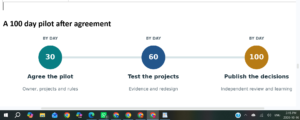
By day 30: Appoint a government lead and independent reviewers. Select projects; agree requirements, disclosure, community participation and a funded workplan.
By day 60: Appraise projects, test climate and fiscal assumptions and assign corrections. Record changes made through community input.
By day 100: Publish independently reviewed decisions, gaps and improvements. Assess costs, usability and reviewer consistency before expanding.
Measure improvement rather than pass rates
Track critical claims verified, overdue corrections, maintenance funding secured, reviewer agreement and changes arising from participation. After implementation, measure service interruptions and recovery times against a baseline.
EVIDENCE AND THE ROAD TO COP31
An African contribution to global practice
African leadership can be demonstrated through practical methods, transparent results and institutions able to learn. FFIAS™ offers an organising approach to test through country-led pilots and independent review.
Why this agenda deserves attention
Climate vulnerability: The IPCC identifies West, Central and East Africa among global hotspots of high human vulnerability. Infrastructure decisions must reflect different local hazards, livelihoods and capacities. [2]
Fiscal pressure: The World Bank reports that low- and middle-income countries paid US$415.4 billion in external-debt interest in 2024. This is a global income-group figure, not an Africa-only estimate. It reinforces the case for explicit affordability and fiscal-risk checks. [3]
Institutional readiness: The IMF’s Climate Public Investment Management Assessment already examines climate-aware planning, coordination, appraisal, budgeting and risk management. The proposed pilot should test how FFIAS™ can complement such tools without duplicating or displacing them. [4]
The message to COP31
Africa’s contribution should be judged by the quality of the investments it helps deliver. We invite governments, development finance institutions and climate funds to work with African institutions on a transparent programme of testing and improvement. Communities should see safer services, fairer decisions and clearer routes to remedy. Financing partners should see traceable evidence, accountable delivery and realistic costs.
Our request is to support the pilot, finance the capacity it needs, and assess the results openly. African experience can help shape stronger global practice.
Meeting context: The IMF–World Bank Annual Meetings take place in Bangkok on 12–18 October 2026. COP31 is scheduled for 9–20 November 2026 in Antalya, Türkiye. This statement is offered for policy dialogue during that period. [1, 5]
Status and use: This is an independent policy proposal. FFIAS™ is presented for piloting, not as an adopted IMF, World Bank, DFI or UNFCCC standard. It does not confer financing eligibility, certification or legal approval. Decisions remain with the competent authorities and financing institutions.
Selected sources
[1] International Monetary Fund. (2026). 2026 Annual Meetings.
[2] IPCC. (2022). Climate Change 2022 Impacts Adaptation and Vulnerability, Summary for Policymakers.
[3] World Bank. (2025). International Debt Report 2025, chapter 1.
[4] International Monetary Fund. (n.d.). Climate Public Investment Management Assessment.
[5] UNFCCC. (2026). UN Climate Change Conference Antalya November 2026.
Official sources accessed 16 October 2026. FFIAS™ proposals and pilot milestones are the author’s recommendations.