Dr Itua Joins Global Leaders at COP17 Panel on Blended Finance for Nature
23 October 2026 – GEF Pavilion, COP17, Yerevan, Armenia
Africa needs decision literacy, not more plans, to unlock nature finance, Dr Itua tells UNDP high-level panel. 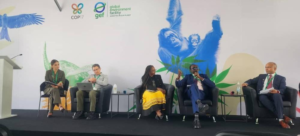 From left: Eva Bortolotti (UNDP, moderator), Andrés Factos (Ecuador), Phindile Masangane (DBSA), Dr Eugene O. Itua (AGESI) and Gaurav Gupta (UNDP).
| EVENT
Panel 2: Blended Finance for Nature |
CONVENER
United Nations Development Programme (UNDP) |
VENUE
GEF Pavilion, COP17, Yerevan |
DATE
23 October 2026 |
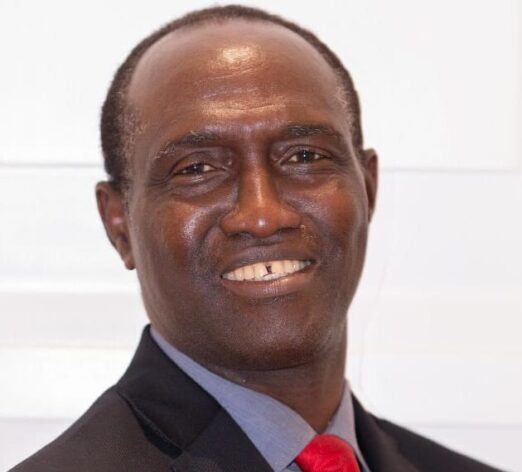
Africa Green Economy and Sustainability Institute (AGESI) Executive Director, Dr Eugene O. Itua, joined an exceptional group of global leaders today at the COP17 side event, “Blended Finance for Nature: From Policy Coherence to Investment”, convened by the United Nations Development Programme (UNDP) at the GEF Pavilion.
Moderated by Eva Bortolotti, Nature Finance Specialist at UNDP’s Planet Hub, the high-level panel brought together influential voices shaping the future of nature finance across regions and institutions. Speakers included:
| Andrés Factos
CBD National Focal Point, Ministry of Environment, Ecuador |
Phindile Masangane
Group Executive, Programmes, Development Bank of Southern Africa (DBSA) |
Dr Eugene O. Itua
Executive Director, Africa Green Economy and Sustainability Institute (AGESI), Nigeria |
| Gaurav Gupta
Blended Finance Advisor, UNDP |
Eva Bortolotti
Moderator · Nature Finance Specialist, UNDP |
OFFICIAL SESSION LINE-UP 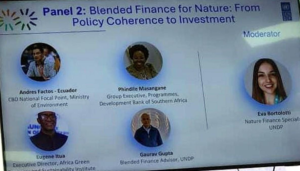 The Panel 2 speaker line-up as displayed at the GEF Pavilion session.
Decision literacy: the capacity Africa needs
Responding to the moderator, Dr Itua said African institutions were built for short-term revenue, not long-term natural capital value.
“Across Africa, the biggest capacity gap is not technical knowledge — it is the ability to turn nature priorities into investable, bankable decisions.”
— Dr Eugene O. Itua, Executive Director, AGESI
He said ministries, regulators and development finance institutions need tools that answer three practical questions:
- What economic value is at risk if nature declines?
- What financial return becomes possible if we restore it?
- How do we structure incentives so that communities benefit first, not last?
Dr Itua presented two systems AGESI is developing to answer them:
| NPDS
Nature-Positive Decision System Turns biodiversity and climate evidence into structured assessments that decision-makers can act on. |
FIPRE
Function · Impact · Prosperity · Resilience · Equity Tests whether a proposal delivers real ecosystem function, measurable impact, prosperity, resilience and equity. |
Together, he said, they make nature finance understandable to the budget officers, bankers and governors who actually approve budgets and loans.
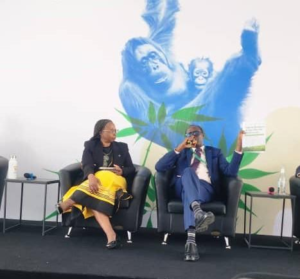
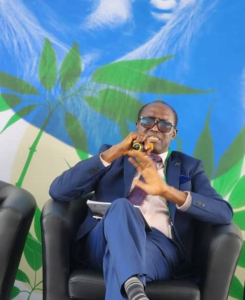 Dr Itua sets out the case for decision literacy, beside Phindile Masangane of DBSA.
Reforming Nigeria’s incentive architecture
Turning to Nigeria, Dr Itua warned that economic incentives still reward depletion more than restoration. He set out four reforms:
| 01
Policy coherence Biodiversity, climate, land-use and development policies must send investors the same signal. |
02
Risk-reduction instruments Guarantees, first-loss capital and blended structures matched to nature-based projects. |
| 03
Fiscal reform Subsidies redirected to restoration, tax incentives for nature-positive firms, and performance-based finance for states and communities. |
04
Natural capital accounting Embedded in national planning and private-sector decision-making, so nature shows on balance sheets. |
He described the Business and Biodiversity Action Plan, through the Business Advisory Group (BAG), as the private-sector delivery system for these reforms. It turns national priorities into corporate investment, disclosure and supply-chain decisions.
Dr Itua closed with a call on sovereignty. If Africa does not publish its own natural capital standard, he argued, it will be forced to adopt external frameworks designed for non-African ecosystems.
“Writing our own standard is not optional; it is a strategic economic necessity. When policies, finance instruments and fiscal measures align, nature becomes a rational investment, not a charitable one.”
— Dr Eugene O. Itua
Themes from the discussion
- National Biodiversity Strategies and Action Plans (NBSAPs) should become investment roadmaps, not only policy documents.
- Blended finance is powerful but not universal; it must be matched to the specific barrier a project faces.
- Guarantees, first-loss capital, concessional finance and risk-sharing instruments are central to scaling nature investment.
- Communities must stay at the centre, with transparent benefit-sharing and safeguards.
- Domestic financial institutions should lead, not follow, global nature-finance trends.
The full panel in discussion at the GEF Pavilion. 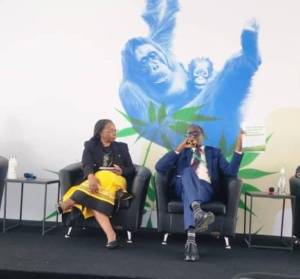 Dr Itua presents an AGESI publication during his intervention.